Lumpectomy vs mastectomy: how to choose what's right for you
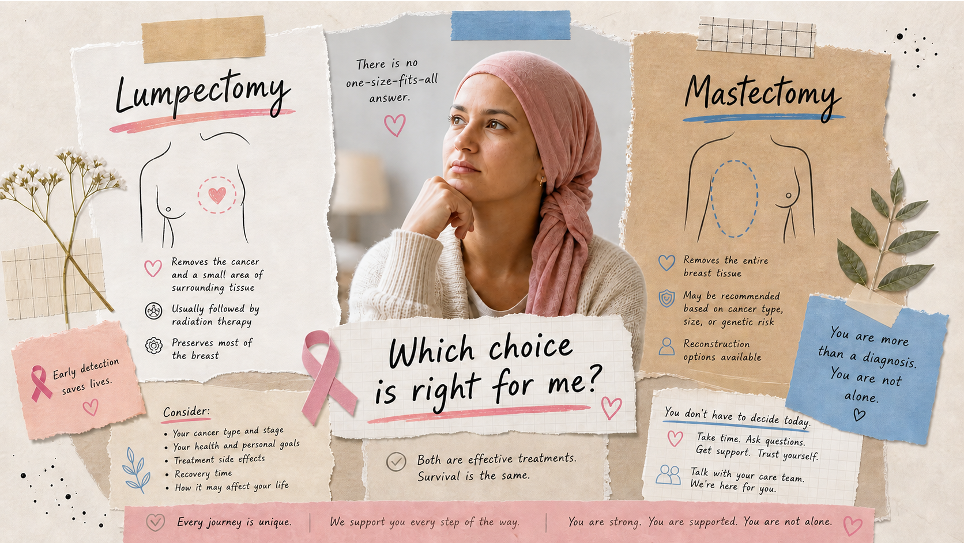
When facing a breast cancer diagnosis, the question of lumpectomy vs mastectomy comes up in almost every consultation. The weight behind that question is real, not just medical, but personal and emotional, tangled up with fear about survival, body image, and the unknown. Every week, I sit across from women working through exactly this decision, and the same concern surfaces each time: "Which operation should I choose?"
Here is what I want you to know before we go any further: for early-stage breast cancer, choosing between lumpectomy and mastectomy is not a choice between living and dying. The evidence does not support that framing. Both operations are valid for the right patient, and your job is not to guess which one is "safer." Your job is to understand both options well enough to make a decision that fits your cancer, your body, and your life. That is exactly what this article is here to help with.
We will cover survival outcomes, local recurrence, recovery timelines, radiation, body image, and reconstruction, before finishing with a practical list of questions to bring to your surgical consultation. By the end, you will have a clear picture of both paths.
Lumpectomy vs mastectomy: does removing more tissue actually improve your odds?
Most patients arrive at their first consultation with a quiet assumption: taking more tissue must mean a better chance of surviving. It is a logical instinct. It is also not what decades of evidence show.
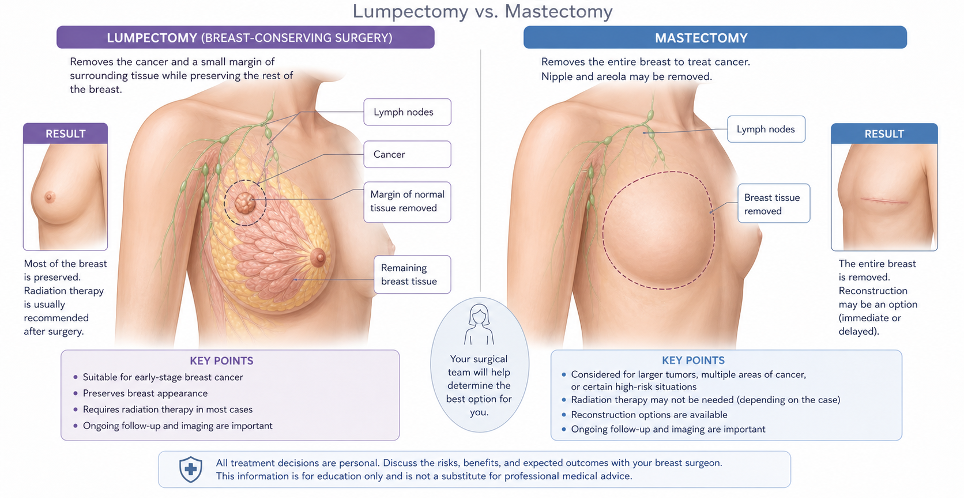
Randomised trial data, including the landmark EBCTCG meta-analyses and summarised in guidelines from NCCN, ASCO, ESMO, and Cancer Australia, consistently find that lumpectomy paired with radiation produces equivalent overall survival to mastectomy for early-stage breast cancer. This is not a fringe finding. It has held up across multiple decades of follow-up data. Keeping the breast, when that is clinically appropriate, is not a compromise on your survival. It is a clinically equivalent choice. For a clear patient-facing explanation of what breast-conserving surgery involves, see the American Cancer Society overview of breast-conserving surgery.
A 2024 systematic review pooling 35 observational studies found a hazard ratio of 0.72 favouring breast-conserving surgery plus radiotherapy over mastectomy for overall survival. That sounds striking, but observational data comes with an important caveat: women selected for breast conservation tend to have smaller, less complex tumours. Patient selection, not the surgery itself, likely explains much of that signal. The honest interpretation is not that lumpectomy is superior to mastectomy. It is that breast conservation is clearly not inferior, and the fear-based assumption driving many women toward mastectomy is not grounded in the evidence.
Lumpectomy vs mastectomy: survival, local recurrence and what actually drives it
Local recurrence is where lumpectomy compared with mastectomy genuinely differs, so the numbers deserve a straight read. In modern clinical series, local recurrence after lumpectomy plus radiation sits at approximately 3 to 10 percent at five years. After mastectomy for early-stage disease, that figure drops to roughly one to two percent. The difference is real. It is also not the whole story.
The biggest drivers of recurrence are tumour biology, receptor subtype, and whether radiation and systemic therapy were used, not which operation was performed. A patient with aggressive triple-negative disease carries higher recurrence risk regardless of her surgical choice.
Recurrence after lumpectomy can also be treated with subsequent mastectomy. Long-term survival in that scenario remains equivalent to primary mastectomy. That is not a reason to be casual about recurrence, but it does mean the difference in local recurrence rates between the two operations does not translate into a proportional difference in survival.
What actually determines whether you are a candidate for breast conservation, also called wide local excision or Breast Conserving Surgery | Dr Sandra Krishnan, comes down to several clinical factors. I will work through all of these with you:
- The ratio of tumour size to breast volume (not tumour size in isolation)
- Whether disease is unifocal or multicentric
- Achieving negative margins (no tumour on ink for invasive cancer; two millimetres or more for DCIS)
- The absence of diffuse malignant microcalcifications
- Your ability to receive radiation afterwards
- BRCA1 or BRCA2 mutation status, which is a relative contraindication requiring careful counselling rather than an automatic disqualification
Node-positive disease, for the record, does not automatically rule out breast conservation. These are clinical questions for your surgeon, not a self-assessment checklist.
Lumpectomy vs mastectomy: recovery and what the timelines actually look like
Lumpectomy is typically performed as day surgery or with a single overnight stay. Most women return to light activity within a few days to a week, and the surgical recovery itself is manageable. The part patients often underestimate is what comes after: adjuvant radiation is standard of care following breast conservation, and it extends the total treatment period considerably. Most patients begin radiation three to six weeks post-surgery and attend daily sessions over a course of several weeks. The operation heals quickly; the overall treatment journey takes longer than the surgery alone suggests.
Mastectomy involves a larger operation and a longer recovery arc. Most women return to basic daily activities within two to six weeks, with the timeline extending further if reconstruction is part of the plan. Drain management and shoulder mobility exercises are standard parts of recovery, and fatigue from a bigger procedure is common.
In Australia, the national breast reconstruction rate after mastectomy sits at approximately 17 to 18 percent. Among women who do reconstruct, implant-based methods account for around 44 percent, autologous tissue flap reconstruction for around 41 percent, and combined approaches for the remainder. Immediate reconstruction is performed at the time of mastectomy. Delayed reconstruction in the public system is a different matter: Australian data, including state-level audits and BCNA reports, indicate a median wait of over 21 months, with a significant proportion of women waiting longer than 12 months.
Lumpectomy vs mastectomy: radiation, body image, and quality of life
Radiation is routinely recommended after lumpectomy and is the standard component that substantially reduces local recurrence, making breast conservation equivalent to mastectomy for local control. Recommending lumpectomy without it is not standard practice. In selected low-risk patients, and after careful counselling, omission may occasionally be considered, but this is the exception, not the rule. For practical information on the benefits of lumpectomy plus radiation, see the patient information provided by Breastcancer.org.
Side effects and practical considerations
The typical course involves daily outpatient sessions over several weeks, beginning once surgical healing is complete, usually within eight weeks of the operation, or after chemotherapy if systemic treatment is also required. Side effects include fatigue, skin redness and irritation, altered sensation in the breast, and, when lymph nodes are also treated, a risk of shoulder stiffness or arm lymphoedema. Newer evidence also supports shorter radiation schedules in many early breast cancer cases; for more on evolving fractionation and shorter regimens see the NCI summary on shorter radiation therapy.
Logistics and the practical burden
For some women, the practical demands of daily radiation, travel, time off work, childcare, and the sustained impact on daily life, become a deciding factor against breast conservation. That is a completely legitimate reason. If geography or circumstance makes a multi-week daily treatment course genuinely unworkable, that belongs in your conversation with your surgeon.
Body image and quality of life outcomes
Body image sits at the heart of this decision for many women, and it deserves honest acknowledgement. Some women feel more secure choosing mastectomy; others feel strongly about preserving their breast. Neither response is wrong, and neither should be dismissed. What the evidence does show is that quality of life outcomes after both operations are broadly comparable when women are well-informed and well-supported through treatment. Evidence links multidisciplinary care, shared decision-making, and appropriate adjuvant treatment to better quality-of-life outcomes after either operation, outcomes shaped as much by the quality of care as by which surgery was chosen.
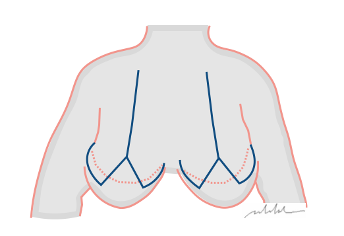
Oncoplastic breast surgery offers a middle path that changes the calculation for some patients. It combines cancer removal with tissue reshaping during the same operation, producing cosmetically comparable results in certain cases while still conserving the breast. It is not suitable for everyone, but it is a technique worth asking about if you are weighing up conservation against removal.
Questions to bring to your surgical consultation
The clinical picture matters, but so do your values. Before you sit down with me, it helps to know what you are trying to find out. These are the questions worth raising:
- Am I eligible for breast-conserving surgery based on my tumour size, location, and extent of disease?
- What are my expected local recurrence rates with each operation, given my specific tumour biology and receptor type?
- Will I need radiation regardless of which surgery I choose?
- What reconstruction options are available to me, and what does timing look like for each?
- Does my family history or BRCA mutation status change this recommendation?
- Are you trained in oncoplastic techniques, and is that approach suitable for my situation?
The clinical evidence narrows the field, but it cannot answer every question. How you feel about radiation treatment, your relationship with your body, your priorities around recovery time, and your tolerance for uncertainty are all part of the decision. Statistics do not carry those answers. A good surgical consultation does.
Why this decision deserves a surgeon who knows both operations well
One of the less-discussed challenges of choosing between lumpectomy and mastectomy is that not every surgeon has equal experience with both operations, or with the oncoplastic techniques that sit between them. A surgeon trained primarily in mastectomy will naturally frame the conversation differently from one who performs both breast conservation and reconstruction with equal frequency and skill.
My consultations are built around shared decision-making: laying out both options clearly, working through the clinical picture specific to each patient, and giving women the space to make an informed choice rather than being steered toward one answer. For patients who are genuinely unsure which path is right for them, sitting with an experienced oncoplastic surgeon who has performed both operations extensively is the clearest way to move forward, see Sydney breast cancer surgeon on early breast cancer treatment for an illustrative discussion.
Associate Professor Sandra Krishnan is a senior oncoplastic breast cancer surgeon based in Sydney, with clinics at Wahroonga, and Westmead. Telehealth consultations are also available for patients who cannot attend in person.
The decision is yours, and it does not have to be made in fear
When weighing lumpectomy vs mastectomy for early-stage breast cancer, this is not a choice between living and dying. The evidence consistently supports both operations when they are used appropriately and in the right clinical setting. What makes the difference is not which surgery you choose, but whether the choice is grounded in accurate information and an honest clinical assessment of your specific situation, with a clear sense of what matters most to you.
The right answer is the one that fits your tumour biology, your physical circumstances, and your capacity to complete adjuvant treatment. A specialist who takes the time to walk through all of that with you, without pushing a preference, is the foundation of a good decision. If you have been recently diagnosed or are currently weighing your surgical options, a consultation with
Dr Sandra Krishnan | Breast Cancer Surgery Sydney can give you the information and the space to choose with confidence.
Social Listings